
Souvenirs from Greece – What to Bring Back from Your Holiday
There’s something about Greece that doesn’t really stay behind when you leave. It follows you home in small, quiet ways – in the smell of olive oil on your hands, in the memory of slow evenings by the sea, in the way even ordinary bread suddenly feels like it should taste better than it does back home. And at some point during your trip, usually while wandering through a small shop in a narrow street or a local market that smells faintly of herbs and sun-warmed stone, you start thinking: I should take a piece of this with me.
Souvenirs from Greece aren’t just objects. The good ones are reminders – of places you didn’t plan to love as much as you did, of conversations you half-understood but fully felt, of that strange Mediterranean calm that makes time slow down without asking permission. And luckily, Greece is full of things that carry exactly that feeling.
Olive oil, olives and the everyday taste of Greece
If there is one thing that quietly defines Greece, it is olive oil. Not as a product, but as a way of life. You notice it first in simple meals – a salad that tastes like it was assembled with intention rather than ingredients, bread that arrives at the table already waiting to be dipped, dishes that don’t try too hard because they don’t need to.
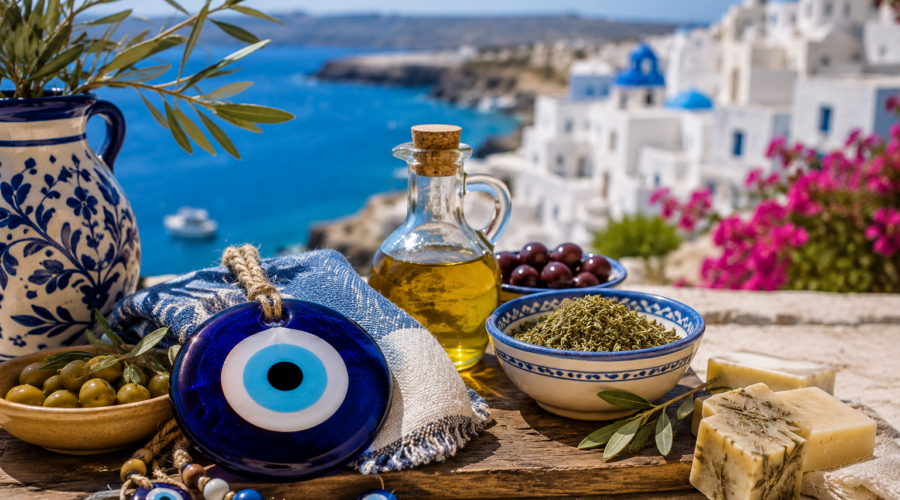
Taking olive oil home feels almost like bottling a memory. The best bottles usually come from small producers in Crete, the Peloponnese or Lesvos, where families still treat olive harvesting as something closer to tradition than industry. The flavor is often sharper, greener, sometimes slightly peppery in a way that surprises you if you’re used to supermarket versions. It’s the kind of souvenir that doesn’t sit on a shelf – it disappears slowly, meal by meal, long after the holiday is over.
And then there are olives themselves, especially the deep purple Kalamata ones that somehow taste nothing like the “olive” flavor many people grow up with. Alongside them you’ll find pastes, tapenades, jars of marinated varieties, each slightly different depending on the region. Add to that a bag of dried oregano or thyme picked from the hills, and suddenly your kitchen at home starts to feel like a very quiet version of a Greek taverna.
Regional specialties you only really understand once you’ve been there
Some of the most interesting things you can bring back from Greece don’t make sense until you’ve actually been to the places they come from. They’re tied to specific islands, specific soil, sometimes even specific trees that don’t grow anywhere else.
Take mastic from Chios, for example. It’s not just a flavour or an ingredient – it’s a whole landscape distilled into resin. Locals will casually mention it while you’re trying a dessert or a liqueur, but once you learn that it only comes from this one island, from trees that “cry” drops of resin in the summer heat, it suddenly feels much more special. It carries this slightly pine-like, almost nostalgic aroma that stays in your memory longer than you expect.
Then there are pistachios from Aegina, which somehow manage to taste more intense than pistachios anywhere else. They’re smaller, a bit darker, and often sold still in their shells, as if they prefer to keep things simple. On Corfu, it’s kumquat that steals the spotlight – a fruit you might barely notice at first, until you try it as a liqueur or jam and realise it tastes like sunshine that’s been slightly preserved in sugar.
And in northern Greece, saffron from Kozani adds another layer to this idea of edible souvenirs that are more story than product. It’s expensive, yes, but it also feels like something you don’t just buy – you adopt it for a while, bring it home, and use sparingly, almost ceremonially.
Sweet things, strong drinks and the souvenirs people actually remember
If there is one category of souvenirs that almost always survives the journey home intact, it is food. Not the fancy kind you carefully preserve, but the kind that gets opened on a random evening when you’re trying to extend your holiday feeling for just a little bit longer.
Greek honey is a perfect example of this. It doesn’t behave like ordinary honey. Thyme honey especially has a bold, herbal depth that feels almost wild, as if it hasn’t quite been tamed by jars and labels. You can imagine bees flying through dry hills rather than neat farms, and that image somehow translates into taste.
Then there are the classic sweets – baklava dripping with syrup, loukoumi that sticks slightly to your fingers, halva that crumbles in a very specific, satisfying way. They’re not subtle, and they’re not trying to be. They’re the kind of treats that are meant to be shared, even if “sharing” often just means opening the box and slowly finishing it yourself over a few days.
Greek coffee, on the other hand, is less about taste and more about ritual. It brings back slow mornings, small cups, conversations that don’t rush anywhere. And if you’re the kind of traveller who enjoys recreating atmosphere at home, a bag of it can do more than you’d expect.
For something stronger, ouzo or tsipouro carry that unmistakable Mediterranean sharpness – not drinks you casually sip, but ones that immediately bring back late evenings, loud tables, and the slightly chaotic warmth of Greek social life.
Natural cosmetics that feel more like tradition than beauty products
One thing that often surprises visitors is how deeply Greece’s natural ingredients extend beyond food. Olive oil, mastic, herbs – they don’t stop at the kitchen. They move into skincare, perfumes, soaps, and small everyday products that feel almost like extensions of the landscape itself.
Olive oil soaps are probably the easiest entry point. They’re simple, slightly rustic, and smell like something that belongs more in a village than a shop. Mastic-based cosmetics, on the other hand, feel more distinctive – fresh, slightly resinous, and very tied to Chios in a way that makes them feel like you’re carrying a fragment of a specific island rather than just a product.
Even the perfumes and essential oils lean heavily into this natural identity. Lavender, rosemary, sage – nothing overly engineered, just scents that remind you of walking through dry paths in the heat of the afternoon when everything smells stronger than usual.
Handicrafts, symbols and objects that actually tell a story
The longer you travel around Greece, the more you realise that the most meaningful souvenirs are often made by hand, not factory. Ceramics painted in blue and white, slightly imperfect bowls that feel alive because of their imperfections, or olive wood objects where no two pieces look the same – they all carry a sense of time that mass-produced souvenirs simply don’t have.
Natural sea sponges from Kalymnos are a good example of this quiet tradition. They’re not flashy, not decorative in any obvious way, but they carry decades of maritime history. You hold one in your hand and it’s hard not to think about the divers who once made a living collecting them from the sea floor.
Then there’s the famous “mati” – the blue eye that you see everywhere once you start noticing it. On bracelets, hanging in doorways, painted on ceramics. It’s simple, almost minimal, but it has this cultural weight behind it, a shared belief in protection that crosses generations.
Leather sandals, linen clothing, woven textiles – all of them continue this idea of usefulness mixed with tradition. Nothing feels over-designed. Everything feels like it was made to be worn, used, lived in.
A small note on shopping in Greece
It’s easy to get carried away when everything feels authentic and beautiful, but not everything sold as a “traditional souvenir” actually is. Many items in tourist areas are mass-produced elsewhere, so it’s worth paying attention to where things come from and, if possible, buying directly from local artisans or small shops. It makes a difference not only in quality but also in the feeling you take home with you – because somehow, knowing the story behind an object changes how you see it later.
Greece has a way of turning ordinary things into memories. A bottle of olive oil, a small ceramic plate, a simple bracelet with a blue eye – none of these objects are spectacular on their own, but they become something else once they’re tied to places you’ve walked through and moments you didn’t want to end.
And maybe that’s the real idea behind souvenirs here. They’re not meant to impress anyone. They’re meant to quietly remind you, weeks or months later, that somewhere under the Greek sun, life felt a little slower, a little warmer, and a lot more present than usual.